Precision & speed#
Important
spotter is an approximate forward model. Light curves precision is expected to be no better than 1 ppm for most practical applications.
Overall precision#
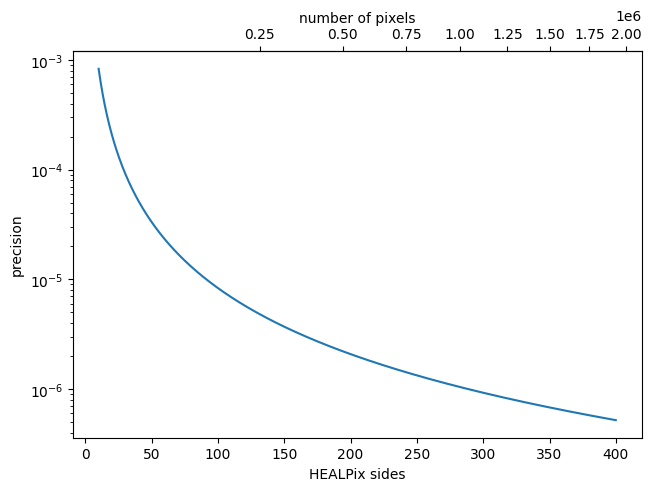
The overall light curve precision of spotter depends on the resolution of the surface, which depends on the number of HEALPix sides used to describe it. A lower bound on the precision can be simply computed with
import healpy as hp

n_sides = 100
lower_precision = 1 / hp.nside2npix(n_sides)

print(f"{lower_precision:.2e}")
8.33e-06
Let’s plot the precision for different number of HEALPix sides
import numpy as np
import matplotlib.pyplot as plt

Ns = np.linspace(10, 400, 1000)
precision = 1 / np.vectorize(hp.nside2npix)(Ns)

fig, ax = plt.subplots(layout="constrained")
ax.plot(Ns, precision)
secax = ax.secondary_xaxis(
    "top", functions=(hp.nside2npix, lambda x: np.sqrt(x / 12.0))
)
secax.set_xlabel("number of pixels")

plt.yscale("log")
plt.ylabel("precision")
_ = plt.xlabel("HEALPix sides")
Transit light curves#
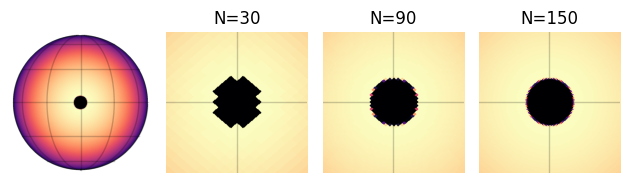
In order to evaluate transit light curves, spotter project the exoplanet disk onto the stellar surface pixels. This leads to high errors depending on the number of HEALPix sides used.
Let’s show the exoplanet pixelated disk for different number of sides.
import numpy as np
import matplotlib.pyplot as plt
from spotter import Star, light_curves, viz


star = Star.from_sides(100)
N = np.linspace(30, 150, 3).astype(int)
r = 0.1

plt.subplot(1, len(N) + 1, 1)
X = light_curves.transit_design_matrix(Star.from_sides(100), 0, 0, 1, r, 0)
viz.show(X[0])

for i, n in enumerate(N):
    plt.subplot(1, len(N) + 1, i + 2)
    X = light_curves.transit_design_matrix(Star.from_sides(int(n)), 0, 0, 1, r, 0)
    viz.show(X[0])
    plt.xlim(3 * np.array([-1, 1]) * r)
    plt.ylim(3 * np.array([-1, 1]) * r)
    plt.title(f"N={n}")

plt.tight_layout()
Let now see the effect on a light curve precision
import jax
from spotter import light_curves

# impact parameter
b = np.linspace(-1.5, 1.5, 300)

for i, n in enumerate(N):
    star = star.from_sides(int(n), u=(0.1, 0.4))
    flux = jax.vmap(lambda b: light_curves.transit_light_curve(star, y=b, z=1, r=r))(b)
    plt.plot(b, flux, label=f"N={n}")

plt.legend()
plt.xlabel("impact parameter")
plt.ylabel("relative flux")
plt.tight_layout()
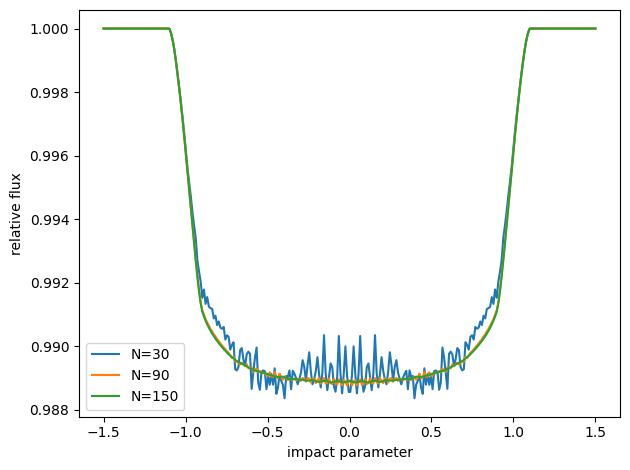
In this case too, the number computed in the last section provides a good lower bound on the light curve precision.
Speed#
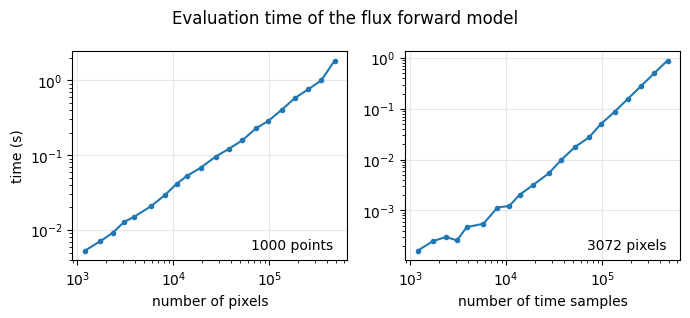
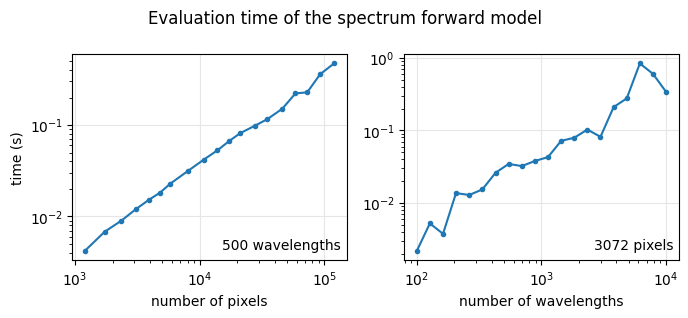
For reference, below are some figures to benchmark the speed of spotter