
Principle#
The idea of spotter is to represent stellar maps using the HEALPix subdivision scheme in order to compute their spectra and light curves. The advantage of HEALPix is its equal-area pixels, which simplifies a lot of computations. Here is an example of an HEALPix map
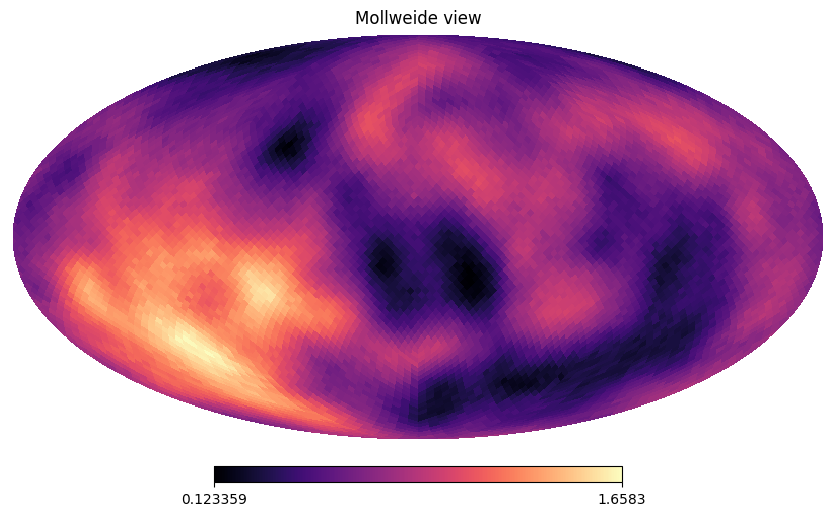
Using HEALPix, this map simply consists in a flat vector \(y\) that contains the values of each pixel (to see how this particular map was generated, check out the Surface GP tutorial).
The idea of spotter is to compute observables, such as light curves, radial velocities, or spectra, from this kind of maps in a linear way. For example, assuming a given inclination and polynomial limb darkening coefficients, the integrated flux of the map can be simply expressed as
where at a given time, \(X\) can be constructed by computing:
The pixels belonging to the visible hemisphere of the map
The projected area of each pixel
The limb darkening intensity of each pixel
Let’s visualize these components

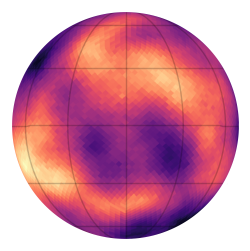
Hence the final map is

Or in orthographic view
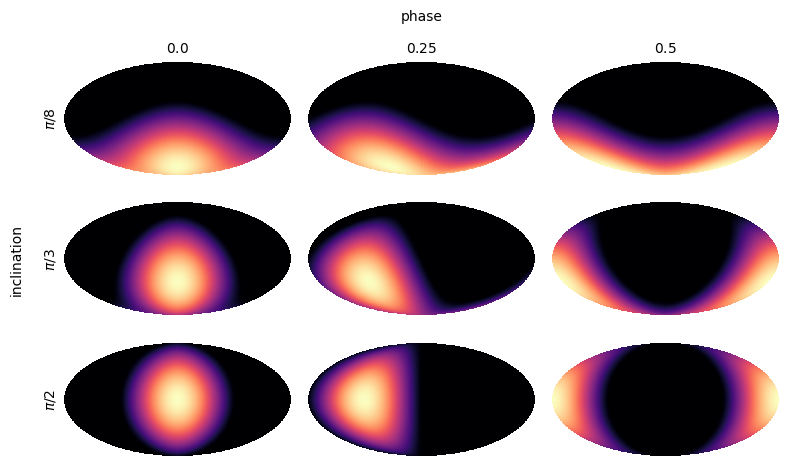
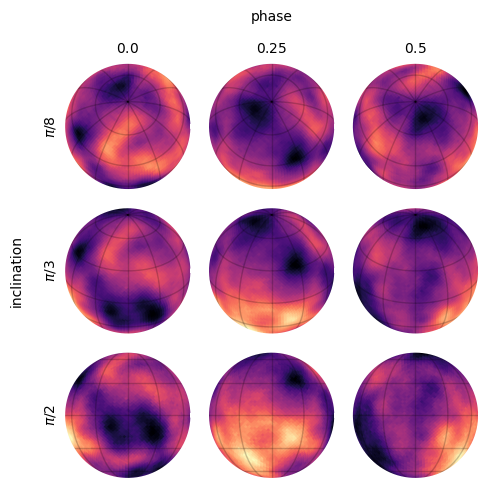
Using these principles, computing the map (and its observables such as the flux) at different inclinations or phases, simply consists in recomputing \(X\), while the map of the star is unchanged. For example here is \(X\) computed at 3 different inclinations and phases
And the resulting map in orthographic views
Using the same principle, we can compute the Doppler shift of each pixel and compute the integrated spectra of a spectral map (see the Doppler maps tutorial).